- With Brits hungry for produce which provides health, heritage and convenience, it’s time to get excited about Japanese fermented foods

Fermented foods are undoubtedly a hot tip when it comes to getting the appetites of food lovers whirring in 2026, and with consumers increasingly appreciating the craftsmanship, heritage and quality behind what they consume – all prime facets of Japanese food culture – it’s only natural that Japanese fermented foods are an exciting opportunity for fine food retailers right now.
On 12th October, an event celebrating Japanese fermented foods was hosted by JETRO (Japan External Trade Organisation) in London, where demonstrations and dishes prepared by cookbook author and influencer Kenji Morimoto and chef Akemi Yokoyama wowed industry professionals including top-class chefs and inspired them to adopt Japanese fermented foods within their menus.

An exciting proposition
The message was clear: in Britain, where health, convenience and quality are at the top of shoppers’ agendas, Japanese fermented foods can deliver premium opportunities for consumers to benefit their health and deliver delicious meals with ease.
Indeed, the UK market is awash with foods which claim health benefits, and the fine food shopper is regularly on the hunt for products which boost health simply and naturally… meaning that Japanese fermented foods with their gut and health-boosting properties mastered through centuries of natural craftsmanship are the perfect fit for Speciality Food readers looking to tap into the demand for better.
The session proved that Japanese fermented foods provide an almost instantaneous burst of flavour – music to the ears of busy home cooks. Attendees compared red akazu with rice vinegar and chicken stock both with and without umeboshi, and relished spaghetti boosted with the addition of natto/iburigakko and savoury yellowtail marinated and seasoned with shio-koji, all of which presented an exciting flavour experience.
Flexibility and versatility are also of paramount importance to British foodies, and so the bitter leaf and burrata salad enhanced by ehime citrus and ponzu, butterbean miso hummus served with charred tamara oyster mushroom, quick pickled onions and togarashi, miso whipped butter atop sourdough and miso sticky toffee pudding crepe cake demonstrated the impressive versatility of these key Japanese ingredients.
The fundamentals of Japanese fermented foods
Many fermented Japanese foods have become staples of British cupboards in recent years, and while consumers are familiar with their intense flavour they remain unaware of the varying options available. For example, tamari is made without the use of wheat, making it a delicious alternative to soy sauce which is conventionally created using wheat and soybeans, and there is far more to miso than the white and red options our palates are becoming increasingly familiar with.
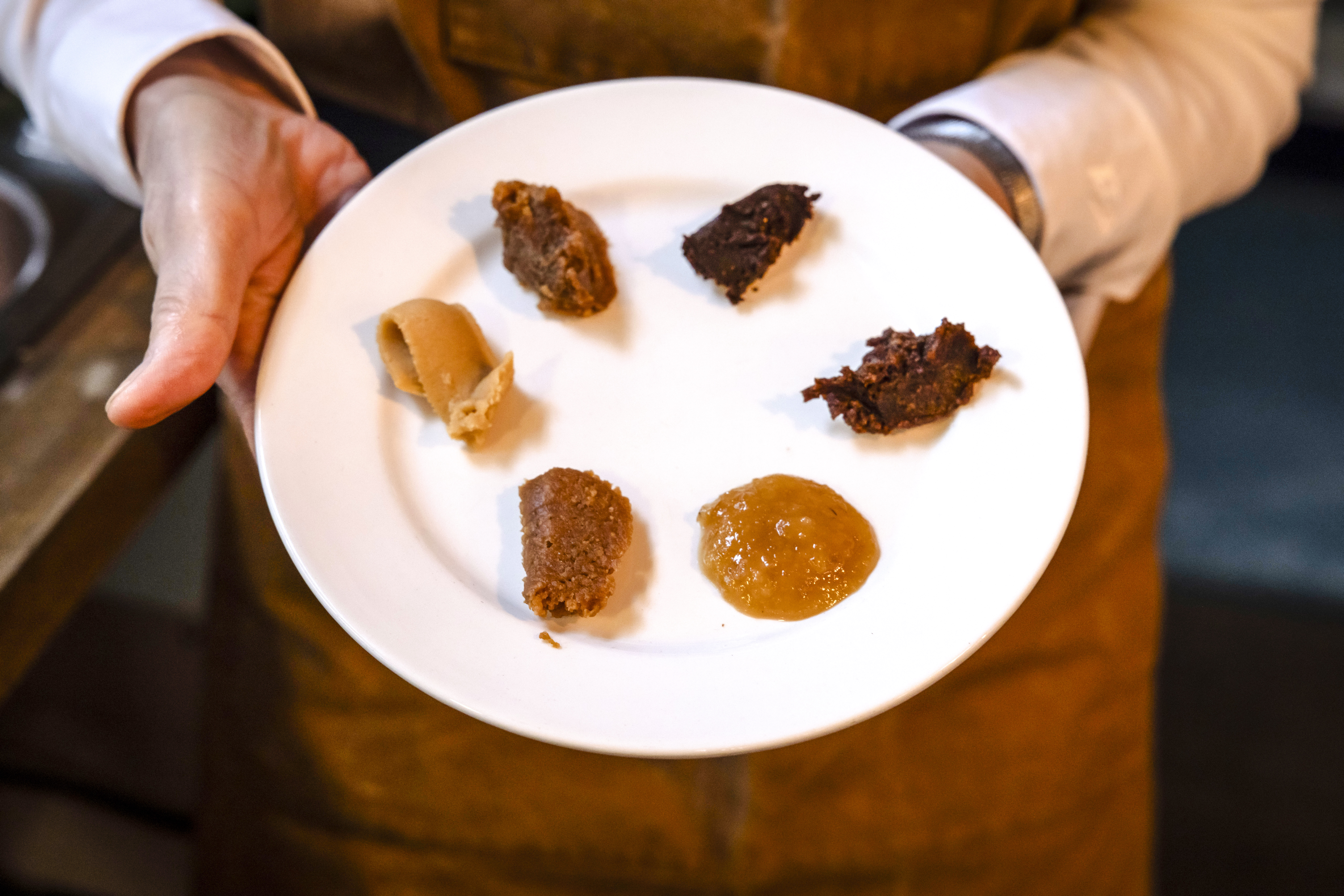
Miso is an important seasoning in many UK kitchens thanks to its savoury and salty taste as well as its lactic acidity which balances sweetness, but there are many more variations than most British consumers are aware of. Attendees to JETRO‘s event sampled white and red miso – commonly used in sweet and delicate or in more savoury preparations, respectively – as well as creamy miso with koji, country-style miso which demonstrated an intense salty tang, hatcho miso with its impressively complex flavour and dark colour, and yuzu miso which offered a sweet-salty marmalade-like experience.
Natto, fermented soybeans with an umami-rich flavour and distinctive sticky texture, alongside Iburigakko, smoked and rice bran-fermented daikon; Shio-koji, a tenderising and umami-enhancing seasoning; Akazu, a versatile red vinegar offering deep umami notes and mellow acidity; and Umeboshi, salted and preserved plums with a sour and savoury bite; are also new discoveries for British palates and well worth the attention of fine food retailers.

A taste of culinary adventure
A true powerhouse behind many world-renowned Japanese fermented foods including soy sauce, miso, and sake and rice vinegar, koji is a filamentous fungus which produces large quantities of extracellular enzymes which convert starches into fermentable sugars and break down proteins into savoury amino acids.
Meanwhile, foods preserved with lactic acid offer perhaps the most unfamiliar culinary adventure for British food lovers. Tsukemono is a common form of fermentation and will look familiar to fans of European vegetable preserves such as sauerkraut, while Nukazuke is a simple but effective form of fermentation which involves burying vegetables in a mixture of toasted rice bran, salt, water and kombu, and populating it with bacteria and yeasts. Katsuobushi is an exciting proposition for chefs and fine food retailers alike with its complex and savoury flavours, a result of skipjack tuna being boiled and repeatedly smoked then inoculated with Aspergillus glaucus mould until hard and rich in flavour.

A growing opportunity
The British demand for what Japanese fermented food provides is strong, but regulatory factors are slowing the movement of products into our market – meaning that while there are plenty of standout products available which perfectly cater for our domestic appetites, there is plenty still to come…
“Japanese cuisine is becoming bigger and bigger in the UK, and British people are becoming increasingly interested in the country’s food and drink offering – but the UK’s regulation is still a challenge,” says Yuko Ozaki from JETRO‘s Agriculture and Food Division. “Many Japanese producers would like to enter the UK market, but there is a big difference between the regulations of the two countries which means that it’s not easy to bring excellent products onto UK shelves. Clearspring are one example of a business that is doing a brilliant job in this regard, and there is plenty of scope for this opportunity to become bigger for retailers.”
Retailers interested in stocking genuine Japanese products have an exciting resource in the form of Japan Street – an online catalogue service which gives retailers access to 95,000 products and 11,700 Japanese suppliers across multiple sectors including food and drink, with the support of JETRO.
Click here