Free digital copy
Get Speciality Food magazine delivered to your inbox FREE
Get your free copy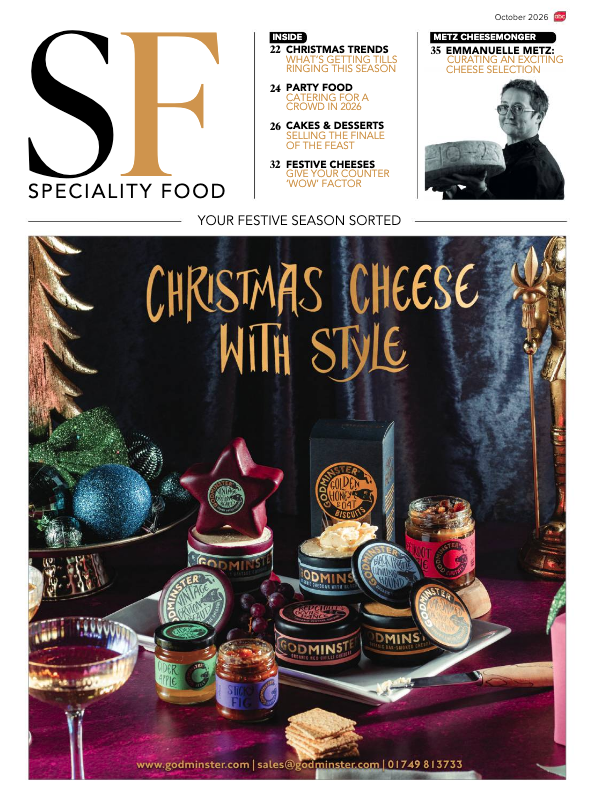

Mark Kacary of The Norfolk Deli shares where he believes the opportunity in fine food retail lies.
There are two ways to interpret the outlook for fine food retail in the current climate.
The pessimistic reading is easy. Global instability, energy volatility, persistent cost inflation and fragile supply chains are putting pressure on margins while consumers grow more cautious. Household budgets are tightening. Spend is being questioned. Value is scrutinised more closely than it has been for years.
Viewed through that lens, premium and speciality food can appear vulnerable. The assumption is familiar: when finances tighten, shoppers trade down. For retailers outside the discount sector, that can make the road ahead look
uncomfortable.
But economic pressure doesn’t just suppress spending, it redirects it.
When uncertainty rises, large discretionary purchases are often the first to be reconsidered.
Expensive travel, long-haul holidays and high-ticket leisure become harder to justify. And when those bigger-ticket plans pause, spending doesn’t vanish, it
reallocates into smaller, closer-to-home rewards.
That shift hasn’t fully played out yet, but it is a direction the market repeatedly moves in during periods of strain. The question for fine food retail is whether the sector is prepared.
If consumers choose to stay closer to home, the appetite for enjoyment and escapism doesn’t disappear. It simply looks for different outlets. Food and drink are natural beneficiaries. Premium becomes easier to justify when it replaces a larger expense.
This is where opportunity lies.
Fine food retailers should be positioning for a rise in domestic occasion spending: luxurious meals at home, relaxed entertaining, outdoor gatherings, grazing moments and social occasions where quality enhances the experience.
Hosting remains emotional currency, and people rarely compromise when feeding friends and family. Ranges built around sharing, picnics, curated selections, artisan cheese and charcuterie, and craft drinks align directly with that likely shift in behaviour. A well-executed at-home food experience can deliver the same sense of treat as a weekend away at a fraction of the cost.
There is also the reassurance factor. In uncertain times, consumers tend to value authenticity, provenance and visible expertise. Specialist retailers are well placed to provide that confidence through curation, knowledge and connection to producers.
None of this removes the pressures facing the sector. Costs remain high and competition is intense. But positioning fine food purely as discretionary luxury risks missing the behavioural direction travel often takes in challenging periods.
The opportunity is not accidental. It requires preparation. Retailers who plan for a move towards affordable indulgence, social food occasions and trusted local expertise will be better placed if as history suggests consumers begin seeking comfort and reward closer to home.
Uncertain times don’t remove the desire for enjoyment. They change where people look for it.
Will Docker of Balgove Larder explains why storytelling is at the centre of small retailers’ value proposition.
Perception of value is so subjective that it is hard to distill down to a shortlist. You can feel ‘ripped off’ when buying a much needed £4 petrol station sandwich, but feel like a £50 lunch was incredible value.
Price, taste and expectations are real influences, but how you feel about a food experience has so many influences – ambience, how your day has been, who you are with, how the food is presented, how it is sold to you and critically what is its story - how did it get to the shelf/ counter?
Supermarkets have obviously forged a massive role in our nation’s consumer habits. That said they have become increasingly routine for large proportions of the population. A function of living that fails to feed the passion that excellent ingredients and food can deliver.
There is little excitement in the supermarket shop! We present value to our customers through experience, excellent quality produce and through trust that what we are doing is as good as we can do it.
We let the produce speak for itself, often acknowledging that we do not do anything clever, we just do it as it should be done and opt for process and skill over corner cutting and margin extortion. We will not sell something that we do not feel is good value.
Everything influences the definition of value from how and where you were raised, all the experiences you have had along the way – from visual, taste, your family and peers – your own personal values and life choices. All this feeds into value perception, there is almost no limit! And it will and should continually evolve.
The UK remains behind the regionally acclaimed food and drink legacies that are prevalent in Europe and much of the world, though we are catching up! The balance is definitely shifting more towards holistic value perception, but price will likely always be the lead for the majority of consumers.
Marketing outstanding produce has played a key part of this shift and the ever improving storytelling. Recent inflationary years have certainly shifted the dial back to focus more on price but taste and quality will always win.
I have always loved the saying that ‘seeing is deceiving, eating is believing’ and the final judgement of the market’s perception of good value is in the repeat purchase.